Design your way,
with AI you already use.

  • Claude Desktop
  • Claude Web
  • Codex
  • CursorComing soon
  • ZedComing soon
  • WindsurfComing soon
  • VS CodeComing soon

dirhp organizes Rhino designs so AI assistants like Claude and ChatGPT knows what objects in your models are, not just their shapes.

Free early accessSee what your agent can doHow it works

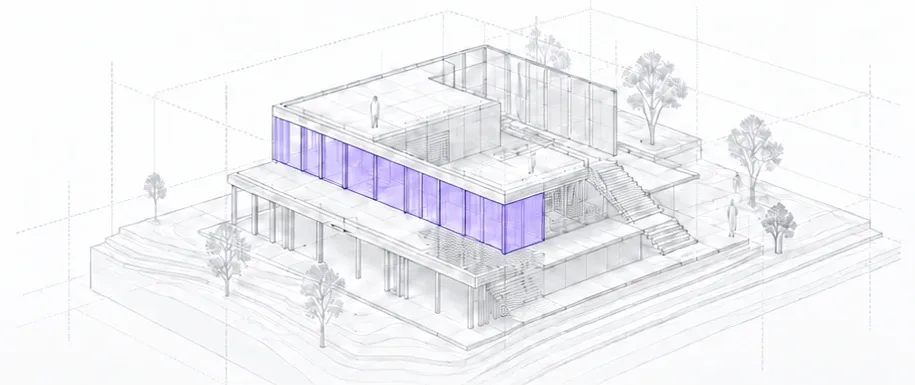
Animated demo. An assistant is asked about a building model in Rhino. It tints each object by what it is: structure, cladding, frames, glass and roof. It is then asked to label all the glass, and fills in thickness, type, supplier and product on every glass object at once. Finally it is asked to bring back an earlier design option, and the model switches to that version.

To your AI, every object is a shape.

Designers keep the meaning by hand.

The model holds geometry. Meaning sits in attributes, layer names, and in the designer's head.

Layers are renamed to find things again. Quantities are counted by eye. Checks are repeated because nothing records that they were done.

Each change starts it over. The layer list is the record.

Layers

8 of 16 layers

Hover or tap ? to see what a name doesn't tell you.

Your assistant has to guess.

A typical CAD file holds surfaces, curves and solids. It does not hold facts about objects.

An assistant asked to change them has to go looking. Read the layers. Pull the objects. Get their metadata. Sort through them. Guess. Repeat.

Unreliable on real models.

Hover any object. Type and attributes are everything the file knows about it.

Your AI assistant, with dirhp

It knows what you mean

What this means

Refer to parts of your model the way you talk about the project, and your assistant acts on the right objects.

In the video

Ask your assistant to enlarge the two seating openings. It resizes both and regrades every panel around them. The storage floor stays as it is.

It does the data entry

What this means

Your assistant names, numbers and tags objects for you, the same way every time, so exports and other tools get clean data.

In the video

Ask it to prepare unique façade panels for the fabricator. Every panel gets an ID, size and finish as Rhino user text.

It knows the design history

What this means

Tag design options as you present them, and your assistant can bring them back weeks later without touching your current work.

In the video

Ask for the options shown to the client last week. Your assistant finds and loads them next to the current design, with a summary of how they differ.

How dirhp works

bed

Meaning

Dirhp attaches meaning to objects as you design with your assistant.

This is what lets an assistant find the right things in a sea of objects.

INTENT “Apply a hexagonal tessellation to a surface.” GEOMETRY IT PRODUCED REMEMBERED INTENTS

Intent

A design approach is remembered, not tied to the geometry it happened to produce.

Design assistants can apply it on another project without you having to describe it again.

living bed bath kitchen version a larger kitchen, no study living bed bath kitchen study version b study, smaller kitchen

History

What happened, and when. The model keeps snapshots of itself.

A question about a previous design version has an answer that doesn't just depend on memory.

Keep your tools. Give your assistant the design context.

dirhp is the connection between tools. It holds what things are, and it keeps that knowledge as the design changes.

Your AI assistant
dirhpCreate and organize designs

Design context

  • MeaningWhat things are and why they exist.
  • DecisionsDesign intent and trade-offs.
  • HistoryHow the model evolved over time.
Your AI assistant uses your modelling tools, such as Rhino MCP, Grasshopper, Rhino and your own scripts, together with dirhp. All of them work on the same Rhino model. dirhp keeps the design context of that model, its meaning, decisions and history, and gives it back to your AI assistant.

WORKS WITH MULTIPLE ASSISTANTS

dirhp speaks MCP, an open standard, so it is not tied to one assistant.

Tested

  • Claude Desktop
  • Claude Code
  • ChatGPT
  • Codex

Should work, not yet tested

  • Cursor
  • VS Code / Copilot
  • Windsurf
  • Zed
  • Cline
  • Continue
  • Other MCP clients

If you write your own logic

Declare a convention once, then re-apply it

The rules your practice works to— how computationally generated geometry map to fabrication schedules, which metadata properties apply to which objects, which elements need a fire rating recorded —can be declared once and re-applied. On the next edit, and on the next project.

Because the rules describe meaning rather than geometry, they survive the model changing shape. Logic that compounds, instead of manual trace-overs you perform by hand every time you tweak a slider.

DESIGN EXAMPLE: ONE RULE, EVERY PANEL

Rule: "If panel deviation > 2°, classify as Bespoke_Curved. Else, Standard_Flat."

Panels are classified by how far they deviate from flat: the tightest curvature comes back as Bespoke_Curved, everything else as Standard_Flat. The rule names the intent, not the geometry, so it holds when the surface underneath it changes.

Standard_Flat Qty: 412 Bespoke_Curved Radius: 4.2m

220 panels · 32 above tolerance

Dirhp is definitely for you if...

  • —You model in Rhino.
  • —You already use an AI assistant most days.
  • —You are willing to use early software on a real project and say what breaks.
Free early access

The tools that dirhp provides your assistants run on dirhp's servers.

If you are not sure if your work is under terms that restrict third-party processing, talk to us before you install.

You want drawings, sheets or schedules out of it. That is not part of dirhp today.

How to get it

dirhp needs two pieces to work: the agent plugin in your AI assistant and the Rhino plugin in Rhino. Install both.

01

Agent plugin

Repository to paste

https://github.com/JovinLim/dirhp-plugins
  1. 01Open Claude Desktop or go to claude.ai, then click Customize in the sidebar.
  2. 02Open the Plugins tab.
  3. 03Click the + button and choose Add marketplace.
  4. 04Select Add from a repository, paste the repository URL above and confirm.
  5. 05dirhp now appears in the plugins list. Click Add.
  6. 06Open the dirhp plugin and go to its Connectors tab.
  7. 07Click Connect and follow the prompts to finish.
  8. 08Your browser opens a new tab asking for an authentication token. Paste your token and complete the sign-in.Contact dirhp team for token
  9. 09Start a new chat. dirhp is ready to use straight away.
  10. 10Optional: add dirhp-architecture for the architecture add-on (still needs the base dirhp plugin).
  1. 01Add the dirhp marketplace in your terminal.claude plugin marketplace add JovinLim/dirhp-plugins
  2. 02Install the dirhp plugin.claude plugin install dirhp@dirhp-marketplace
  3. 03Start Claude Code with claude and run /mcp.
  4. 04Select dirhp from the server list and choose Authenticate.
  5. 05Your browser opens a new tab asking for an authentication token. Paste your token and complete the sign-in.Contact dirhp team for token
  6. 06Start a new session. dirhp is ready to use straight away.
  7. 07Optional: add dirhp-architecture for the architecture add-on (still needs the base dirhp plugin).
  1. 01Open the ChatGPT desktop app (or Codex) and go to Plugins.
  2. 02Click Add a marketplace.
  3. 03Paste the repository URL above and confirm.
  4. 04Switch to the Personal tab.
  5. 05Find dirhp in the list and click Install.
  6. 06Optional: install dirhp-architecture the same way for the architecture pack.
  1. 01Add the dirhp marketplace in your terminal.codex plugin marketplace add JovinLim/dirhp-plugins
  2. 02Install the dirhp plugin.codex plugin add dirhp@dirhp-marketplace
  3. 03Sign dirhp in to its connector.codex mcp login dirhp
  4. 04If the browser does not open on its own, copy the link Codex prints into your browser.
  5. 05Your browser opens a new tab asking for an authentication token. Paste your token and complete the sign-in.Contact dirhp team for token
  6. 06Start a new session. dirhp is ready to use straight away.
  7. 07Optional: add dirhp-architecture for the architecture add-on (still needs the base dirhp plugin).

Start a new session or thread after installing.

dirhp-architecture needs the base dirhp plugin for its connection.

02

Rhino plugin

Download dirhp.yak

01

Open Rhino and drag the .yak file into the Rhino window to install.

02

Restart Rhino, then run the dirhp_Panel command to check it is installed.

Questions

Both let an assistant work in Rhino. They cover different ground, and you can run them together.

RhinoMCP gives an assistant a way to operate Rhino. dirhp does that too, but it also holds what the objects in your model are, in your words, and keeps that as the design changes. So when you ask for the shopfront glazing, the answer already exists instead of being worked out from scratch each time.

Use one, or use both. dirhp does not take anything away.

dirhp sees baked geometry. Once results are in the Rhino document, they can be named, found and tracked like anything else. Live Grasshopper preview is not visible to dirhp.

How dirhp should work with Grasshopper is an open question, and we would rather answer it with you than guess. If you work this way, tell us what you need.

Three things are involved, and they are separate.

Your Rhino file stays where it is. dirhp reads it on your machine. The .3dm is not uploaded.

The design graph is processed on our servers. That covers the names you give things, how they relate, your version history, your recipes and policies, and the geometry-derived data needed to answer questions about the model. Dependency checking and version history run there.

Your AI assistant stays yours. It runs on your own account with your own provider, under their terms. dirhp does not see your conversations and does not connect to your provider on your behalf. What dirhp receives are the requests your assistant sends to it.

Nothing from your projects is used to train any model. dirhp is in early access and this will keep developing; changes will be published here.

Read the full data and privacy page.

No. dirhp has no fixed set of object types. You describe things in the words your practice already uses — shopfront, party wall, canopy — and one object can hold more than one meaning at the same time. A seat that is also a stair does not have to become one or the other.

You do not declare anything before you draw. Describe things when you know what they are, which is rarely at the start.

Yes. dirhp reads your existing Rhino file. No conversion, no export, no new file format, and your layers and object names stay as they are.

You describe what things are as you go, so an existing model does not need preparing before you start.

Rhino 8 on Windows, the dirhp plugin, and an AI assistant that supports MCP. Claude Desktop and Claude Code are the tested ones today.

Install the plugin, connect your assistant, and an account is created the first time you connect.

Nothing during early access. Pricing has not been decided, and there is no charge to try it.

This stage is about a small group of people using dirhp on real projects and telling us what breaks. If you already work with AI assistants every day and you model in Rhino, that is exactly the feedback we need. Early users are shaping what this becomes — and you will hear about any pricing change from us first.

Not today. dirhp is about what is in the model and what it means. Drawing output is not part of it yet.

Changes made through your assistant are ordinary Rhino edits. They appear in the viewport and they undo like anything else. Saved states let you return the design to an earlier version.

Free early access

Model in Rhino with the AI you already use. Leave your email and we will send the plugin and setup instructions.